Relationship with regional NGOs and governments for SDG policy (17.2.1 )
Széchenyi István University actively supports SDG 17 through collaborations with governments, international organisations, NGOs, industry partners, cultural institutions, and higher education institutions. These partnerships contribute to policy development, research, innovation, education, data sharing, and the dissemination of good practices in support of sustainable development.
|
Horizon Europe & Interreg Danube Projects (EU-funded consortia, NGO & ministry partners) Széchenyi István University won multiple grants announced in 2025, with national and international partners representing several sectors. The aim of these projects is to support sustainable development by reflecting on the needs articulated by challenges impacting the society. https://admissions.sze.hu/sze-secures-horizon-europe-interreg-danube-grants These include: |
|
.webp "Kép (5).webp")
|
Széchenyi University has been awarded a grant in the Interreg Danube competition, partly funded by the European Union. Dr Gábor Guti, a member of the Natural Aquatic Fish Management Research Group, is responsible for overseeing the success of the international research on fish management. The three-year project aims to establish and test a cross-border system for monitoring sturgeon and protecting migratory fish in the Danube. The international research project, led by the Romanian Ministry of Environment, Water and Forestry, also involves the participation of the World Wide Fund for Nature (WWF), the Central and Eastern European Environment Organisation, and the State University of Moldova. https://admissions.sze.hu/sze-secures-horizon-europe-interreg-danube-grants https://interreg-danube.eu/projects/monstur-in-the-danube/about-us Széchenyi University has been awarded a grant in the Interreg Danube competition, partly funded by the European Union. Dr Gábor Guti, a member of the Natural Aquatic Fish Management Research Group, is responsible for overseeing the success of the international research on fish management. The three-year project aims to establish and test a cross-border system for monitoring sturgeon and protecting migratory fish in the Danube. The international research project, led by the Romanian Ministry of Environment, Water and Forestry, also involves the participation of the World Wide Fund for Nature (WWF), the Central and Eastern European Environment Organisation, and the State University of Moldova. https://admissions.sze.hu/sze-secures-horizon-europe-interreg-danube-grants https://interreg-danube.eu/projects/monstur-in-the-danube/about-us The TRANSFER Danube project aims to analyze the new patterns of climatic extreme events (drought, floods, heat waves, e.g.) and design/develop the necessary tools for agriculture in the Danube region in order to be able to properly adapt and respond to such challenges. The project will develop a Danube transnational e-platform that will integrate climatic/water resources/agriculture database, maps, knowledge, tools, modelling, good practices for water management, for reducing drought in order to be prepared and adapt to climate change in the vulnerable areas for crops in the Danube Region. The lead partner is the National Meteorological Administration in Romania, and partners include universities (e.g. University of Natural Resources and Life Sciences, Vienna; Széchenyi István University, Hungary), nonprofit organizations (Central Danube Development Agency Nonprofit Ltd., Hungary; Association “Centre for Sustainability and Economic Growth”, Bulgaria) and business partner (Sensum, business consulting firm, Croatia). https://interreg-danube.eu/projects/transfer-danube/about-us |
Logo of Interreg Danube Region |
|
HORIZON-MISS-2024-Ocean-01-02 tender, Széchenyi University secured a HUF 110 million grant for its research project titled "Sustainable Water Management and Integrated Management of Fish Migration and Habitats in the Danube River Basin and the North-Western Black Sea. - SWIM". The project supports the implementation of the European Green Deal, the Biodiversity Strategy, the Water Framework Directive, the Habitats Directive, and policies for the protection of freshwater ecosystems by monitoring and protecting fish habitats and species. The project fosters transnational cooperation among stakeholders, including governmental bodies, NGOs, researchers, and local communities, through the SWIM Alliance. The two-year research project is led by the University of Zagreb in Croatia, in partnership with institutions such as the Catholic University of Eichstätt-Ingolstadt in Germany, the Danube Delta National Institute for Research and Development in Romania, and the Technical University of Košice in Slovakia. The project will be coordinated by Dr Katalin Bene, Associate Professor at the Department of Transport Infrastructure and Water Resources Engineering at Széchenyi University. |
Logo of Horizon Mission |
|
Horizon-CL6-2024 climate project targets climate protection actions. On the Hungarian side, the five-year climate protection research will be led by Dr István Kulmány, head of the Agricultural and Food Industry Research Centre at the Smart Farm in Mosonmagyaróvár. The ClimateSmartExperiments (CSE) programme aims to establish and coordinate an active network of research stations and associated research communities across all EU Member States and associated countries, with the goal of developing joint, creative research approaches and innovative solutions for climate change mitigation and adaptation. The consortium will be led by research institutes of the Dutch Stichting Wageningen, with partners including the University of Leeds in the UK, the French National Institute for Agricultural Research, and the Cypriot Ministry of Agriculture, Rural Development and Environment. https://palyazat.sze.hu/horizon-cl6-2024-climate-02-1-climatesmartresearch https://cordis.europa.eu/project/id/101216573
|
|
.png "WP2025 (003).png")
 Logo of EU Missions
|
National Media and Infocommunications Authority Supports the Research and Development Activities of Széchenyi István University. Széchenyi István University maintains a long-standing strategic partnership with Hungary’s National Media and Infocommunications Authority (NMHH) to advance education, research, and innovation in telecommunications, digitalisation, and information technologies. In 2025, the Authority provided financial support for professional programmes, research activities, and infrastructure development, including projects related to cybersecurity, quantum communication, satellite technologies, and space communications. The cooperation also supports scholarships, curriculum development, conferences, and professional training opportunities for students and researchers. Through this partnership between a higher education institution and a national public authority, Széchenyi István University contributes to scientific advancement, digital innovation, and the development of knowledge and skills needed to address future technological and societal challenges. |
.webp "Kép2 (30).webp") Dr András Lapsánszky, Head of the Department of Public Administrative and Fiscal Law at Széchenyi University's Deák Ferenc Faculty (Photo: Máté Dudás) Dr András Lapsánszky, Head of the Department of Public Administrative and Fiscal Law at Széchenyi University's Deák Ferenc Faculty (Photo: Máté Dudás) |
|
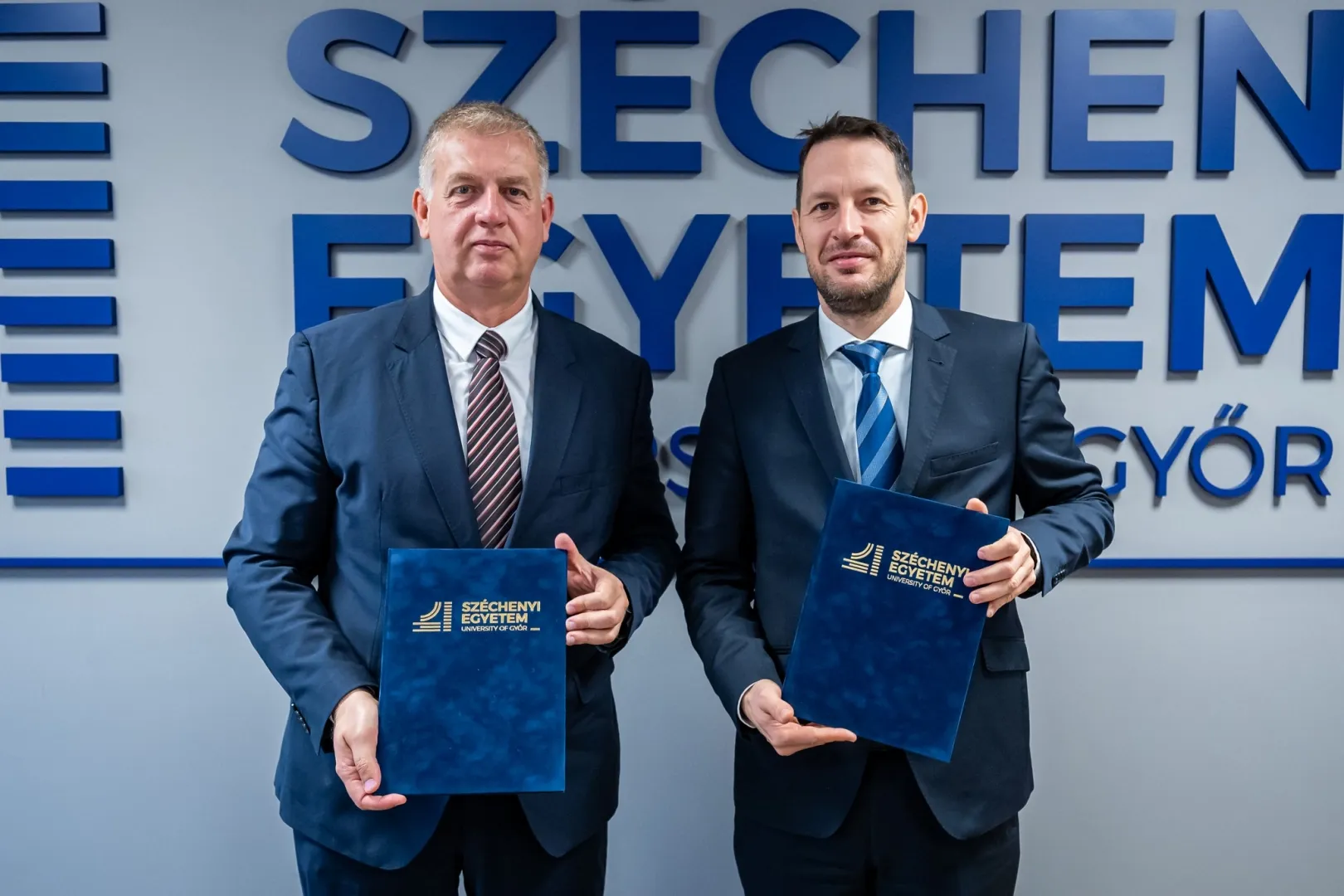
National Intellectual Property Office provides “patent fast track” for Széchenyi István University. Széchenyi István University strengthened its collaboration with the National Intellectual Property Office (SZTNH) through an expanded partnership designed to accelerate the transfer of research results into practical applications. A central element of the agreement is the introduction of a “patent fast track” service, which provides early novelty searches and patentability assessments, enabling researchers to identify promising innovations more efficiently and make informed decisions about intellectual property protection. By supporting knowledge transfer, fostering innovation, and enhancing cooperation between academia and a national public institution, the initiative contributes to a more sustainable innovation ecosystem where research outcomes can generate long-term economic and societal value. The partnership also promotes responsible management of intellectual property and helps ensure that scientific knowledge can be translated into solutions that support sustainable development and competitiveness. |
Szabolcs Farkas andDr Zsolt Kovács signed the agreement (Photo: Máté Dudás) |
|
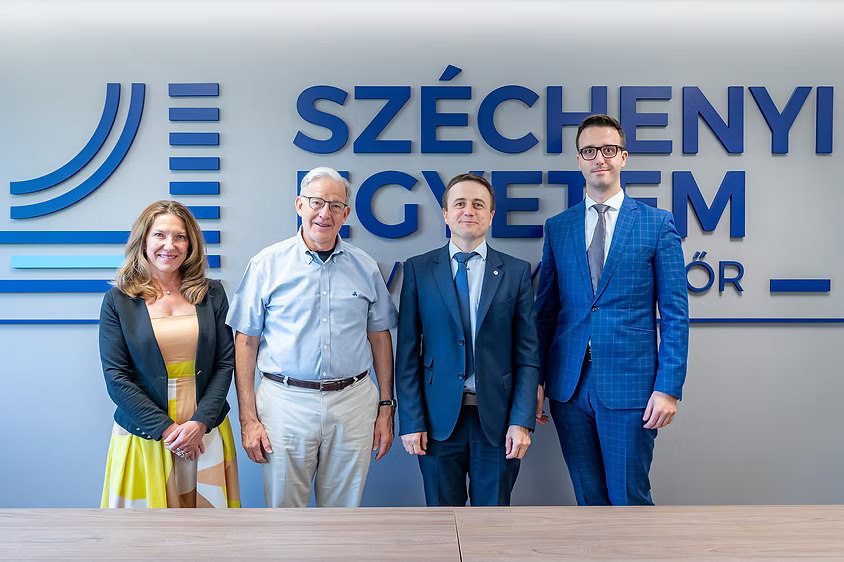
International relations: Nebraska’s Secretary of State visited Széchenyi István University in Győr. Széchenyi István University welcomed a high-level American delegation led by Robert B. Evnen, Secretary of State of Nebraska, to explore opportunities for cooperation in agriculture, innovation, education, and research. Discussions focused on agricultural research, sustainability objectives, agricultural digitalisation, precision farming, and technological development, with the aim of identifying areas for future Hungarian–American collaboration. The visit involved diplomatic representatives and stakeholders from both countries and highlighted shared interests in sustainable development and innovation. By establishing governmental and international relationships that can support future joint research and educational initiatives, the University contributes to strengthening international cooperation and partnerships relevant to sustainable development goals. |
Discussion (Photo: András Adorján) |
|
Climate-Adapted Cities Project. Széchenyi István University participates in the Climate-Adapted (Heat-Resilient) Cities project, a 30‑month cross-border collaboration between Győr (Hungary) and Graz (Austria) aimed at reducing the health risks associated with climate change and heat waves while strengthening urban resilience. The consortium is led by the Municipality of Graz, demonstrating direct cooperation between higher education and local government in the development of evidence-based climate adaptation measures. The project brings together a diverse partnership consisting of Széchenyi István University (Faculty of Health and Sport Sciences), the Municipality of Graz, the United Health and Social Institution of Győr, the St. Andrew Rheumatology Hospital and Medicinal Spa of Hévíz, and the Family and Child Welfare Centre of Győr. The collaboration therefore includes government bodies, healthcare institutions, social service organisations, and civil society/community welfare organisations, ensuring a multi-stakeholder approach to SDG-related policy development and implementation. Within the project, partners conduct situation analyses, develop city-specific interventions, apply a common indicator-based evaluation framework, establish expert networks, deliver training programmes, and organise an international conference in Győr. |
Széchenyi University’s Austro-Hungarian research projects focuses on biodiversity. |