Széchenyi István University tracks pay equity for gender equality through an annual, institution-wide review of employee salary levels. Under the HR Manual (Chapter 8, “Ösztönzési-juttatási rendszer”, p. 47), the University conducts this analysis every year, identifies any anomalies in remuneration, and intervenes to eliminate unjustified inequalities that are contrary to the principle of equal treatment, with special attention paid to preventing gender pay disparities. This monitoring process is reinforced by the Gender Equality Plan (2025-2027), which sets gender balance in recruitment, career development and leadership as a strategic institutional objective and requires gender equality considerations to be integrated into institutional decision-making (“Nemi egyensúly a toborzásban és a karrierépítésben”, p. 6; “A Nemek Közötti Egyenlőségi Terv kidolgozásának alapelvei”, p. 3).
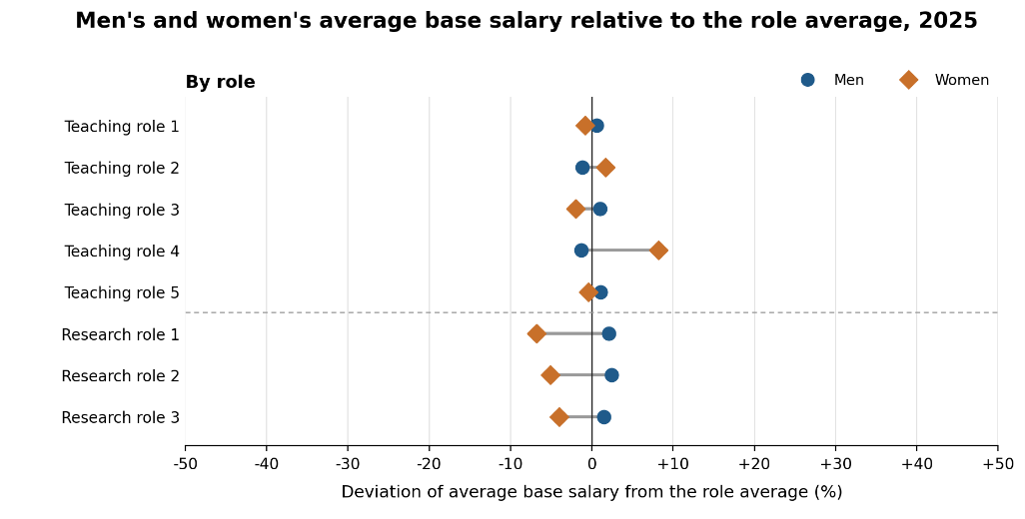
Pay equity is continuously monitored by the Directorate of Human Resources, which provides recommendations to the University’s management to ensure that any significant disparities identified are appropriately addressed by the University. The measures include the average salary level of all employees compared to the average salary of gender groups. This measure shows how the realized salary differs compared to the median and gives the opportunity to measure the gap between man and woman. In 2025, this gap was higher in Research positions compared to Teaching positions.
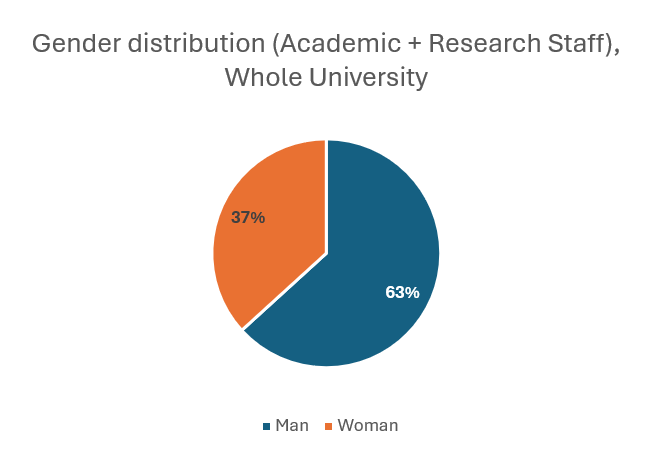
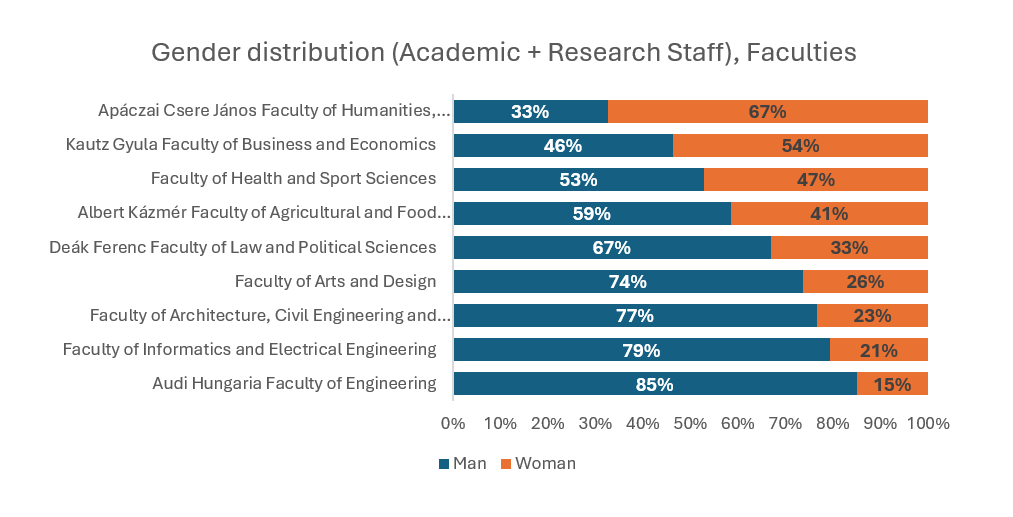
The additional measure is the share of man and woman at the level of university, units/faculties, scientific disciplines (e.g. STEM and non-STEM), as well as at individual job positions. In 2025, women accounted for 37% of employees in academic and research positions. However, this proportion varied considerably across the University’s faculties. While women represent more than half of academic/research staff in some faculties and are comparatively well represented in several early and mid-career teaching positions, their representation is notably lower in STEM-oriented faculties.
We use cookies
This website uses cookies to ensure basic functionality, improve your experience, and for statistics and marketing purposes. Click “Accept all” to allow every cookie, or “Reject” to keep only the strictly necessary ones active.
Choose which cookie categories you allow. Strictly necessary cookies cannot be turned off, because the site will not work without them.
Always active
Required for the basic operation of the site: login, security, cart, forms and remembering your cookie choice. The site cannot work without them, so they cannot be disabled.
Cookie name
Provider
Duration
wordpress_logged_in_*
WordPress
Munkamenet / 14 nap
Identifies the logged-in user.
PHPSESSID
A weboldal
Munkamenet
Server side session identifier.
szesuti_consent
A weboldal (SZetemény)
6 hónap
Stores your cookie preferences so you do not have to decide on every visit.
cmplz_banner-status
A weboldal
cmplz_consented_services
A weboldal
cmplz_functional
A weboldal
cmplz_marketing
A weboldal
cmplz_policy_id
A weboldal
cmplz_preferences
A weboldal
cmplz_statistics
A weboldal
last_pys_landing_page
A weboldal
last_pysTrafficSource
A weboldal
pys_advanced_form_data
A weboldal
pys_first_visit
A weboldal
pys_landing_page
A weboldal
pys_start_session
A weboldal
pysTrafficSource
A weboldal
Enable convenience features such as remembering your language, embedded videos and maps, live chat and social content.
Cookie name
Provider
Duration
wp-settings-*
WordPress
1 év
Stores personal admin interface preferences.
comment_author_*
WordPress
1 év
Remembers the name and e-mail used for comments.
Collect anonymous, aggregated data about how you use the site so we can improve it.
Cookie name
Provider
Duration
_ga
Google Analytics
2 év
Assigns a unique anonymous ID to the visitor for statistics.
_ga_*
Google Analytics 4
2 év
Stores session state for the GA4 data stream.
_gat*
Google Analytics
1 perc
Throttles the request rate.
_gid
Google Analytics
24 óra
Daily anonymous visitor identifier.
Used to personalise ads and measure campaign performance, potentially across other websites too.
Cookie name
Provider
Duration
1P_JAR
Google
1 hónap
Ad measurement and statistics.
_gcl_au
Google Ads
90 nap
Used for ad conversion measurement.
CONSENT
Google / YouTube
2 év
Stores consent state for Google services.
IDE
Google DoubleClick
1 év
Ad personalisation and performance measurement.
NID
Google
6 hónap
Used to personalise Google services.
VISITOR_INFO1_LIVE
YouTube
6 hónap
Measures YouTube player bandwidth and settings.
VISITOR_PRIVACY_METADATA
YouTube
6 hónap
Stores the visitor's privacy (consent) state for YouTube.