Employment practice living wage (8.2.1)

Széchenyi István University ensures that all employees receive at least the living wage – in Hungary the Government defines this each year as the statutory minimum wage and the guaranteed wage minimum – and applies the principle of fair remuneration ensuring a decent standard of living.

HR Manual of Széchenyi István University

The Széchenyi István University’s HR Manual (effective 1 January 2025, adopted by the Governing Board on 16 December 2024, resolution 258/2024 (XII.16.)) explicitly states that, when determining remuneration, the institution observes the United Nations principle of providing a fair wage that guarantees a decent standard of living and ensures the statutory living wage/minimum wage for all employees (HR Manual, Section 8, p. 47).
The HR Manual further states that the University aims to provide employees with financial security and transparent, predictable income opportunities through its remuneration and benefits system (Section 8, p. 47). This includes:

Living Wage and Fair Remuneration

The University’s remuneration policy provides that:

  • remuneration is determined with regard to the principle of a fair wage ensuring a decent standard of living (Section 8, p. 47);
  • all employees are guaranteed at least the living wage/minimum wage established under Hungarian labour legislation (Section 8, p. 47);
  • the remuneration system is designed to provide financial security and predictable, transparent income opportunities (Section 8, p. 47).

Employment practice unions (8.2.2)

Széchenyi István University recognises employees’ rights to freedom of association and collective bargaining through its Collective Agreement concluded with the institutional organisation of the Higher Education Employees’ Trade Union (FDSZ). The Agreement applies to all employees of the University, including those who are not members of the trade union, ensuring equal access to collectively negotiated employment conditions and benefits. The University formally supports the operation of the trade union, provides the conditions necessary for its activities, and guarantees its right to represent employees in matters related to employment, working conditions, social welfare, and labour rights. The trade union is entitled to participate in consultations, express opinions on employer decisions, and engage in collective bargaining on behalf of employees. This is explicitly stated in the scope of the Collective Agreement, which extends to all University employees and confirms that its normative provisions also apply to employees who are not members of the signatory trade union (Introduction, page 3).

The University formally supports the operation of the trade union and guarantees its right to represent employees in matters related to employment, working conditions, social welfare and labour rights. Annex 3 (“Rules Governing the Relationship between the University and the FDSZ Institutional Organisation”) states that the University declares its intention to cooperate with and support the trade union and facilitate its activities (Annex 3, Section 1(a), page 14).

The Agreement further provides that the trade union is entitled to communicate its opinions on employer decisions, initiate consultations, and represent employees regarding their economic, social, living and working conditions (Annex 3, Section 2(a)-(b), page 14).

In addition, the University ensures the practical conditions necessary for union activities, including office space, communication facilities, access to information, and consultation rights (Annex 3, Section 3, pages 14-15).

These provisions apply to all employees regardless of gender, nationality, or trade union membership status, demonstrating the University’s recognition of collective representation and collective bargaining rights for all staff, including women and international employees. The Collective Agreement is concluded with the FDSZ as the University’s representative trade union (Introduction, page 3).

Széchenyi István University’s Trade Union is the institutional branch of the Higher Education Employees’ Trade Union (Felsőoktatási Dolgozók Szakszervezete, FDSZ), the third-largest sectoral trade union in Hungary and a member of the Confederation of Unions of Professionals (Értelmiségi Szakszervezeti Tömörülés, ÉSZT). The union operates independently, with its own institutional leadership, membership structure, and communications, in addition to the rights and benefits set out in the Collective Agreement.

Employment policy on discrimination (8.2.3)

Széchenyi István University has comprehensive policies to prevent discrimination and promote equal treatment in the workplace through its 2025–2027 Equal Opportunities Plan (reviewed in April 2025) and 2025–2027 Gender Equality Plan (reviewed in July 2025). These policies apply to all organisational units and all employees of the University and are aligned with the Hungarian Equal Treatment Act and relevant European equality principles.

The Equal Opportunity Plan (2025–2027)

The Equal Opportunities Plan (2025–2027) explicitly prohibits all forms of discrimination and guarantees equal treatment regardless of age, sex, race, skin colour, nationality, mother tongue, disability, health status, religion or belief, political opinion, family status, sexual orientation, gender identity, social origin, financial status or any other personal characteristic. The prohibition of discrimination covers recruitment, employment, salaries, benefits, training, promotion opportunities, transfers, dismissal and all other employment-related matters (A hátrányos megkülönböztetés tilalma, egyenlő bánásmód biztosítása, pp. 4–5).

The University further commits to:

  • ensuring equal treatment in recruitment and employment practices;
  • eliminating unjustified pay inequalities;
  • providing equal access to benefits, training opportunities and career advancement;
  • supporting parents returning from maternity, parental or childcare leave;
  • promoting family-friendly working arrangements and work-life balance;
  • providing accessible working conditions for employees with disabilities;
  • reducing gender inequalities in employment and leadership positions; and
  • ensuring equal access to lifelong learning and professional development opportunities.


The Gender Equality Plan (2025–2027)

The Gender Equality Plan (2025–2027) establishes specific measures to promote gender equality throughout the institution. The Plan aims to achieve gender balance in leadership and decision-making bodies, ensure equal opportunities in recruitment, selection and promotion procedures, integrate gender equality considerations into teaching and research, and support the reconciliation of work and family life (Bevezetés, p. 2; Intézményi célkitűzések, pp. 4–7)

The Gender Equality Plan also includes measures to:

  • prevent gender-based discrimination and bias;
  • combat sexism, stereotypes, gender-based violence and sexual harassment;
  • provide support for victims and witnesses of harassment;
  • develop gender equality awareness and training programmes; and
  • ensure that institutional policies, decisions and procedures are implemented in accordance with gender equality principles.

Both plans include formal complaint procedures enabling staff members to report violations of equal treatment principles and seek investigation and remedy through designated university bodies.

Employment policy modern slavery (8.2.4)

Institutional Commitment – Code of Conduct

Széchenyi István University has a formal institutional commitment to protecting human rights, promoting equal treatment and ensuring ethical conduct across all areas of its operation. The University’s Code of Conduct applies to all university citizens, including employees, contracted workers, volunteers, visiting students, doctoral candidates and employees of university-owned entities (Code of Conduct, Section 1(1)). The Code further confirms the University’s commitment to respect for human dignity, fundamental rights, equal treatment and non-discrimination (Code of Conduct, Section 2(3)). The Code of Conduct has been in force since 24 May 2023.

The Code of Conduct explicitly states: “The University rejects all forms of forced labour, slavery, human trafficking and child labour.” The University also condemns organised crime, corruption and bribery and requires all university citizens to comply with applicable laws, regulations and institutional policies (Code of Conduct, Sections 2(1) and 2(8)).

To ensure implementation and accountability, the Code establishes an Ethics Committee empowered to investigate alleged breaches of ethical standards and conduct formal ethics procedures. University citizens may initiate ethics proceedings where violations are suspected. Following an investigation, the Ethics Committee may recommend sanctions ranging from a written warning to immediate termination of employment in cases of serious misconduct (Code of Conduct, Section 10(17)).

Employment practice equivalent rights outsourcing (8.2.5)

Institutional Commitment – Code of Conduct

At Széchenyi István University, the rights of people who work for the University outside a standard employment contract are protected by the Code of Conduct (Etikai kódex). Under Section 1(1), the Code covers every person in an employment relationship, a contract for services (megbízási jogviszony) or any other work-related legal relationship with the University, including volunteers, and it extends to the employees of legal entities wholly owned by the University, through which several University services are provided. All of these workers are therefore covered by the same commitments as the University’s own employees: respect for human dignity and fundamental rights, equal treatment and the prohibition of discrimination (Section 2(3)), and the rejection of all forms of forced labour, slavery, human trafficking and child labour (Section 2(7)). Persons connected to the University in other ways, such as employees of companies renting University premises, are expected to respect the University’s ethical principles (Section 1(1)). A breach of the Code can be reported by the person affected or by anyone with credible knowledge of it, and is examined by the Ethics Committee (Sections 9 and 10(1)).

Employment policy pay scale equity (8.2.6)

Széchenyi István University is committed to pay equity and equal treatment in remuneration. The HR Manual (effective 1 January 2025, adopted by the Governing Board on 16 December 2024, resolution 258/2024 (XII.16.)) states that the University applies the principle of equal treatment in setting salaries and actively works to prevent gender pay gaps. To support this commitment, the University conducts annual analyses of employee salary levels, identifies anomalies and intervenes where necessary to eliminate unjustified inequalities that are contrary to the principle of equal treatment (HR Manual, Chapter 8, Ösztönzési-juttatási rendszer, p. 47).

This commitment is reinforced by the University’s Equal Opportunities Plan (2025–2027), which establishes equal treatment and non-discrimination as fundamental principles of employment and requires the promotion of equal opportunities in all employment-related processes, including recruitment, career development and workplace conditions (Esélyegyenlőségi terv 2025–2027, “Általános célok és elvek” and “A hátrányos megkülönböztetés tilalma, egyenlő bánásmód biztosítása”, pp. 3–5)

In addition, the Gender Equality Plan (2025–2027) identifies gender equality as a strategic institutional objective and includes dedicated measures on gender balance in recruitment and career development (Nemi egyensúly a toborzásban és a karrierépítésben, p. 6) and gender balance in leadership and decision-making (Nemi egyensúly megvalósulása a vezetésben és a döntéshozatalban, p. 5). The Plan also states that gender equality considerations must be integrated into institutional policies and decision-making processes (A Nemek Közötti Egyenlőségi Terv kidolgozásának alapelvei, p. 3).

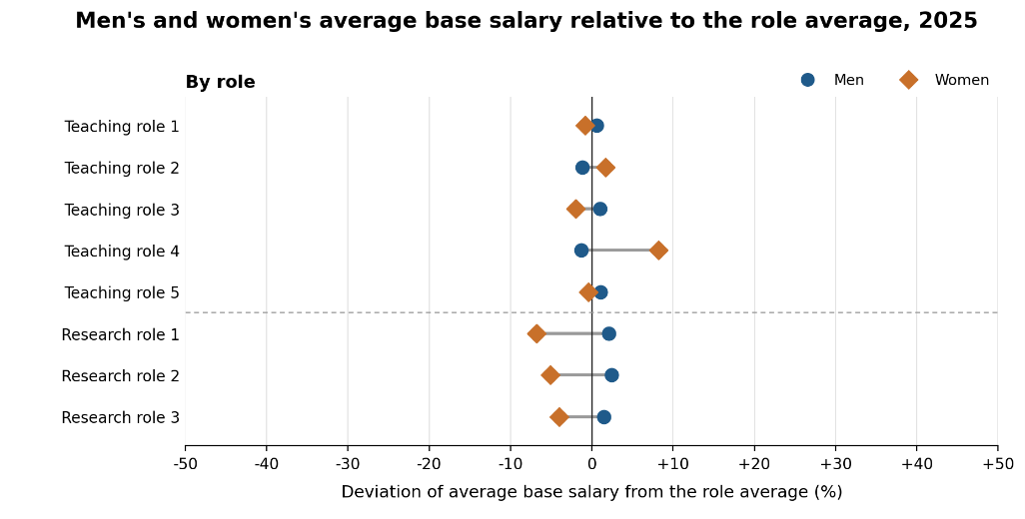
The Directorate of Human Resources of Széchenyi István University on a permanent basis performs pay gap measurements at the level of whole university, as well as at the level of different units/ faculties. The same measure is performed at the level of individual job positions. This includes the average salary level compared to the average salary of gender groups. This measure shows how the realized salary differs compared to the median and gives the opportunity to measure the gap between man and woman.

Tracking pay scale for gender equity (8.2.7)

Széchenyi István University tracks pay equity for gender equality through an annual, institution-wide review of employee salary levels. Under the HR Manual (Chapter 8, “Ösztönzési-juttatási rendszer”, p. 47), the University conducts this analysis every year, identifies any anomalies in remuneration, and intervenes to eliminate unjustified inequalities that are contrary to the principle of equal treatment, with special attention paid to preventing gender pay disparities. This monitoring process is reinforced by the Gender Equality Plan (2025-2027), which sets gender balance in recruitment, career development and leadership as a strategic institutional objective and requires gender equality considerations to be integrated into institutional decision-making (“Nemi egyensúly a toborzásban és a karrierépítésben”, p. 6; “A Nemek Közötti Egyenlőségi Terv kidolgozásának alapelvei”, p. 3).

Pay equity is continuously monitored by the Directorate of Human Resources, which provides recommendations to the University’s management to ensure that any significant disparities identified are appropriately addressed by the University. The measures include the average salary level of all employees compared to the average salary of gender groups. This measure shows how the realized salary differs compared to the median and gives the opportunity to measure the gap between man and woman. In 2025, this gap was higher in Research positions compared to Teaching positions.

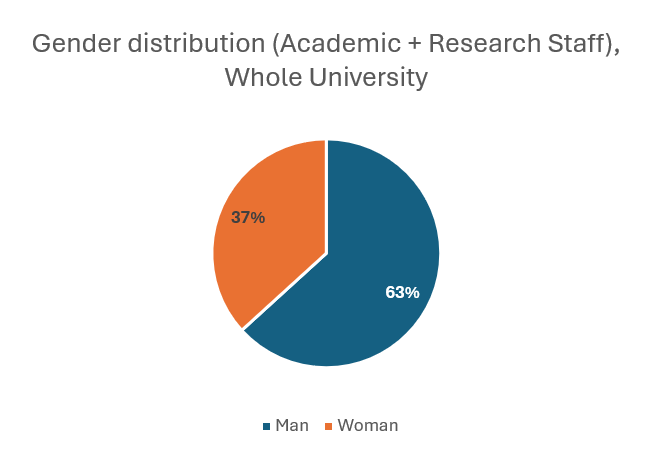
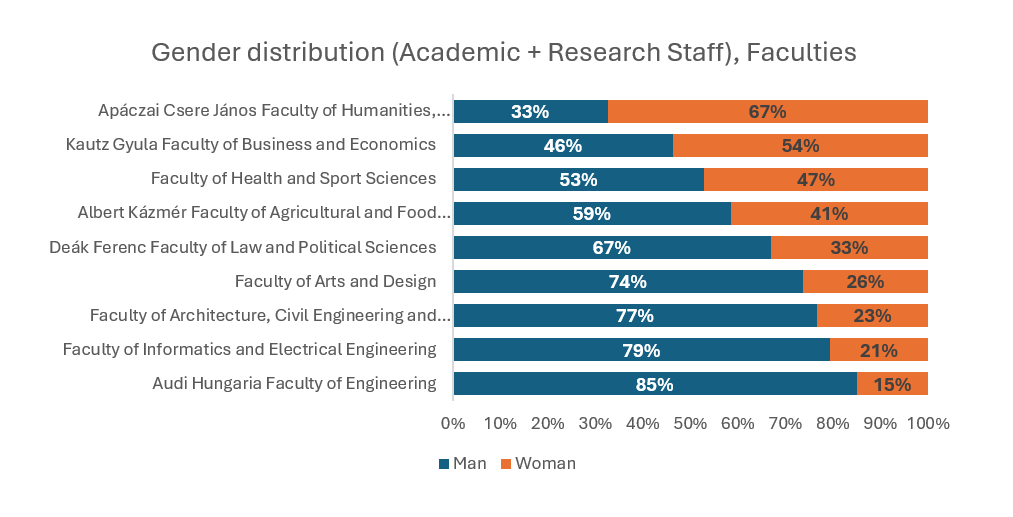
The additional measure is the share of man and woman at the level of university, units/faculties, scientific disciplines (e.g. STEM and non-STEM), as well as at individual job positions. In 2025, women accounted for 37% of employees in academic and research positions. However, this proportion varied considerably across the University’s faculties. While women represent more than half of academic/research staff in some faculties and are comparatively well represented in several early and mid-career teaching positions, their representation is notably lower in STEM-oriented faculties.

Employment practice appeal process (8.2.8)

Széchenyi István University provides formal procedures through which employees can raise concerns and appeal issues related to employment rights, discrimination, equal treatment and workplace conduct.

Under the Equal Opportunities Plan (2025–2027), any employee who believes that the principle of equal treatment has been violated may submit a written complaint to the Vice-President for Education and General Affairs. The complaint is investigated by the competent body, which may include the Ethics Committee, disciplinary bodies, the integrity officer, the trade union or other relevant university entities. Employees are informed in writing about the outcome of the investigation and retain the right to pursue additional legal remedies. (Equal Opportunities Plan, Section 4, p. 9).

The University’s Code of Conduct also establishes a formal Ethics Procedure through which any University citizen may report violations of ethical standards. Complaints are reviewed by the Ethics Committee, which has the authority to investigate cases, hear the parties involved, make determinations and recommend corrective measures or sanctions. Decisions of the Ethics Committee may be appealed to the Rector of the University. (Code of Conduct: The Ethics Committee, The Ethics Procedure)

In addition, the Collective Agreement recognises the role of the representative trade union (FDSZ) in protecting employees’ interests and representing staff in matters concerning employment conditions, social welfare and labour rights. It also provides mechanisms for consultation and dispute resolution between employees and the University.

Pay-related decisions are covered by the same routes: the equal-treatment requirement of the Equal Opportunities Plan expressly extends to salaries and benefits, so an employee who considers a pay decision unfair may file the written complaint and may be represented by the trade union (Collective Agreement, Annex 3, pp. 14–15).

Employment practice labour rights (8.2.9)

Széchenyi István University recognises employees’ rights to freedom of association and collective bargaining through its Collective Agreement, concluded with the institutional organisation of the Higher Education Employees’ Trade Union (FDSZ). The Agreement applies to all University employees, including those who are not members of the trade union, ensuring equal access to collectively negotiated employment conditions, benefits and protections (Bevezető rész, p. 3).

The University formally supports the operation of the trade union and guarantees its participation in employment-related matters. Under Appendix 3: Rules Governing the Relationship between the University and the Institutional Organisation of FDSZ, the trade union has the right to represent employees regarding employment conditions, social welfare, labour rights, and working conditions (2. Az együttműködés jogi és szervezeti alapjai, p. 14). The University also undertakes to provide the conditions necessary for trade union activities and consultation (1. Az Egyetem és az FDSZ Intézményi Szervezetének együttműködése and 3. Az FDSZ Intézményi Szervezet működési feltételeinek biztosítása, pp. 14–15).

The University’s Equal Opportunities Plan (2025–2027) further guarantees equal treatment and prohibits discrimination in all employment-related matters. The section “Általános célok és elvek” and “A hátrányos megkülönböztetés tilalma, egyenlő bánásmód biztosítása” (“General objectives and principles” and “Prohibition of discrimination, ensuring equal treatment”) establishes equal treatment as a fundamental principle, while the Plan commits the University to ensuring equal opportunities in recruitment, employment, remuneration, benefits, training, promotion and dismissal regardless of sex, nationality, ethnicity, religion or belief, disability, family status, sexual orientation, gender identity or other protected characteristics (pp. 3–5).

As the Collective Agreement and Equal Opportunities Plan apply to the entire workforce, freedom of association, collective bargaining rights, and equal employment protections are available to all employees, including women and international staff.

The Trade Union is the institutional branch of the Higher Education Employees’ Trade Union (FDSZ), the third-largest sectoral trade union in Hungary. The Trade Union of Széchenyi István University operates independently, with its own institutional leadership, membership structure and communications.